I have to apologise that this blog has been silent for the first third of the month of May. But it is because my research has been bogged down in literature and my professional career. And so, I will provide what I’ve been doing recently to forward my research, as well as where I will be going from here.

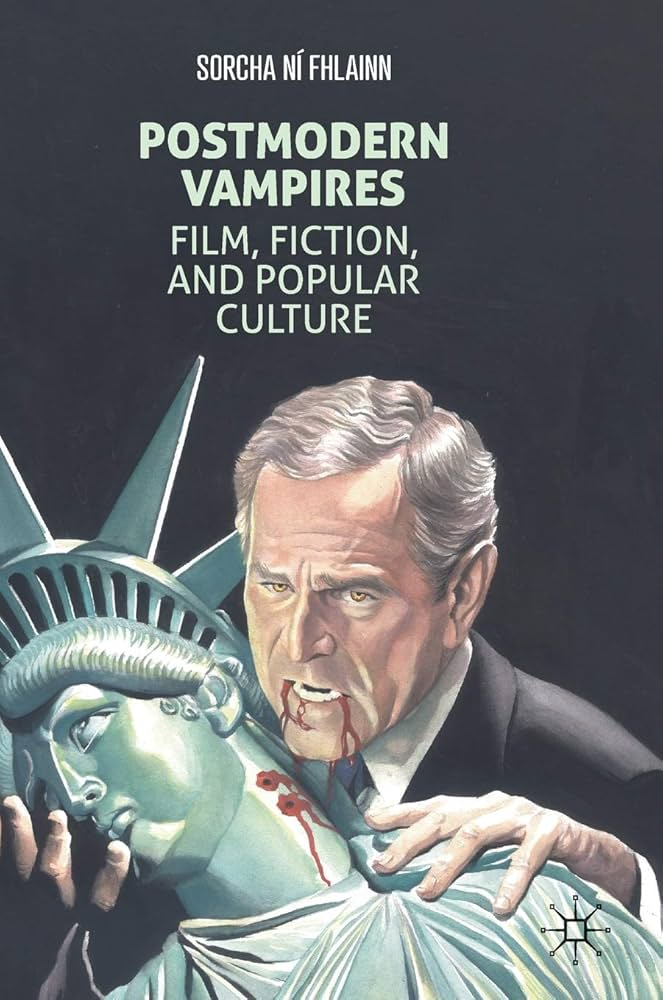
I have been reading the postmodern analysis of vampire fiction by Sorcha Ní Fhlainn, who is a literary scholar that explores pop culture. In this monograph, Ní Fhlainn looks at American vampire fiction as a reflection of American society, beginning with the 1970s and bringing the audience up to the 2010s. As it is a postmodern analysis, it makes several connections to real world events (however tangental) and occasionally introduces international entries when applicable.
As I have gotten to the middle of the 1980s in Ní Fhlainn’s analysis, I have begun to see the the general structure and argumentative style that the author uses. and I have some initial thoughts. First, I want to preface that history and postmodern thinking have a bit of tension as disciplines and ideological frameworks. A fantastic work made by Richard J. Evans details this friction (which I had the pleasure to read in my undergraduate) , and I will provide a footnote for those interested on the topic1. For the sake of this article, the general argument that Evans makes is that postmodern critique is based in literature, and treats the subject of analysis as a standalone artifact that can be debated and critiqued; and that history as a discipline does not adhere entirely to that line of thinking. Whereas texts in literature can be debated on by their meaning, there are certain limitations to what you can argue in history. It also becomes dangerous to perform death of the author, and remove authorial intent from a piece of history; whether it be a piece of fiction or any other historical artifact. These conflicts do not mean; however, that postmodern histories can not exist, and there is a lot that can be gleaned from using a postmodernist lens when looking at certain historical artifacts. There are, as I will point out later, simply limits to doing a full postmodern analysis on historical topics like American vampire fiction.
All of that was to say that I have read Ní Fhlainn’s book before, albeit in small sections, for my undergraduate thesis. It is an interesting resource if you want look into the connection between American politics and vampire fiction during the Cold War. But historically, I think that Ní Fhlainn fell into the postmodern pitfall when doing here analysis. As I have four more chapters to go, I am not saying that her critique is bad, only that there were specific instances that I want to highlight. The main issue I have with her analysis is her use of death of the author to connect these pieces of vampire fiction to American politics of the time, when some of her examples just do not support her argument. I will use an example which I’ve talked about before here, which is Richard Matheson’s I Am Legend novel published in 1954. She writes that:
“In the Shadow of the atomic bomb, home-made shelters, and the palpable fear of communism in the rising tide of Cold War paranoia, undetected infection and apocalyptic annihilation pervade the novel’s positioning of vampirism as a homogenous, all-consuming and unnatural identity; to be infected, in Neville’s eyes, is to belong to a condemned legion. For Matheson, vampirism is akin to an insatiable appetite, an othering which is consumptive and anonymising, wholly abject to Neville’s traditional, patriarchal, and distinctly American individualism. Vampirism is neither Sympathetic nor desirable but nonetheless is positioned at the novel’s conclusion as the evolutionary inevitability of the post-apocalyptic world.” (Ní Fhlainn, 2019, p. 19)
I simply replied in my notes, “And yet he had no intention for allegory of any kind. He simply was interested in a vampire story where the humans were outnumbered by the vampires2.” And it is easy to want to make analyses like Ní Fhlainn is doing here because historians want their argument to be narratively cohesive. But in actuality, history is complex, and in this instance authorial intent does matter when it comes to discussing what I Am Legend is trying to say. I initially believed the same thing Ní Fhlainn did with Matheson’s novel, but to hear him say that he put no allegory intentionally in his story must be respected as well. That isn’t to say that I Am Legend is not coded as a book made during the Cold War (it is afterall a product of it’s time) it just was not a thoughtful commentary on geopolitical or even domestic affairs like Ní Fhlainn is making it out to be.
I am certainly interested in what the rest of the analysis has to offer, because it does provide a good mix of literature and film that makes the overall narrative interesting to read. And I don’t want people -especially Ní Fhlainn if she somehow reads this- to think I dislike her monograph so far. Far from it. I am only giving my impressions and providing where I’m coming from with this research. In fact, I agree largely with the overall theses of each chapter I have read. I will give my full thoughts on the analysis when I am finished, and hopefully have it done before the month is out. As to my next steps, I will be finishing this monograph and hopefully getting back to my science fiction vampire film research, which I think I can provide something new to the literature with. So stay tuned for a review of Postmodern Vampires: Film, Fiction and Popular Culture as well as more science fiction focused vampire film stuff in the future!
- Evans, Richard J. (2000) In Defense of History. W.W. Norton.
↩︎ - “Richard Matheson Interview,” n.d., https://iamlegendarchive.blogspot.com/p/richard-matheson-interview.html. ↩︎
Leave a Reply