Introduction
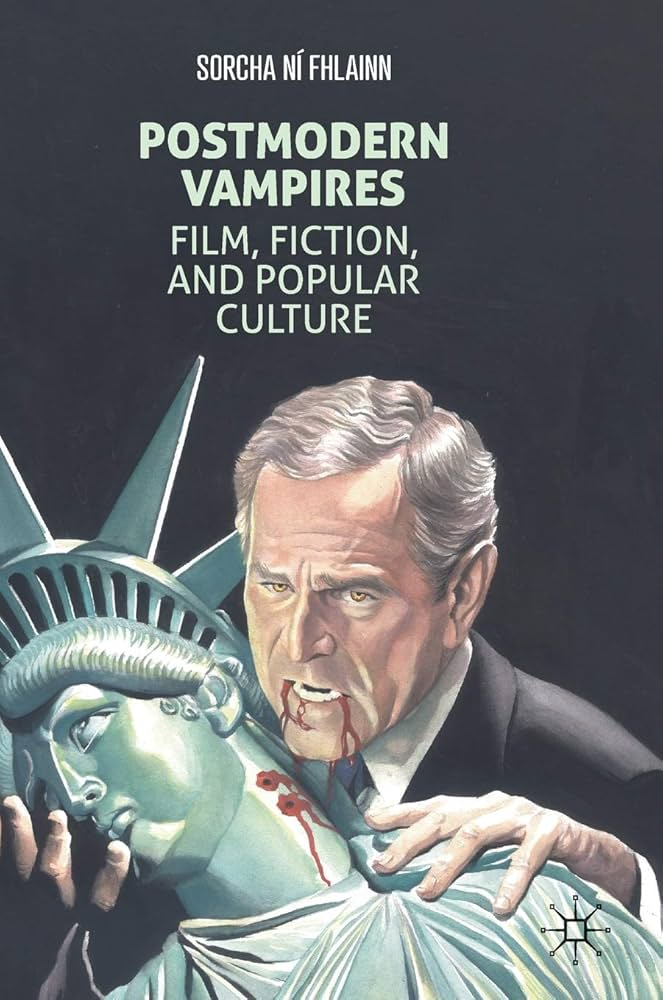
Vampire film -and the larger vampire fiction- have an extended history that has only recently been focused on in academia. One of the main reasons for this is a perceived lack of importance in such a topic in the first place. For how can a niche fictional archetype be relevant to academic culture or even the everyday layman? The recent push of vampire fiction literature has come from largely literary efforts, albeit using a historical framework to create a narrative about how vampires have changed in fiction over time. As the discussion is largely focused on by literary academics, much of their analysis has less emphasis on the historical impact of these works on broader society. This is where Sorcha Ní Fhlainn’s 2019 monograph titled Postmodern Vampires: Film, Fiction & Popular Culture attempts to bridge this gap. What makes this particular analysis different from many others of it’s kind is that the author followed the postmodernist literary doctrine, hence the term ‘postmodern’ in the title. Nevertheless, Ní Fhlainn asserts that, “Within the parameters of this study on Postmodern vampires, it must be noted that I am being led by history” (Ní Fhlainn, 2019, p. 13)”. This work is as much a historical analysis as it is a literary critique of the subject texts being examined. which is where we situate Ní Fhlainn into the ever-expanding vampirology canon.
Ní Fhlainn’s investigation into vampire fiction during the later twentieth century and early twenty-first century has much to glean on a sub-textual level, highlighting themes and broader social and political issues going on in American society through the ‘vampiric lens.’ However, the author’s own framework ultimately loses sight of what a vampire even is in it’s later chapters and engages in death of the author to such a degree that it no longer becomes a historical work and shifts into pure literary critique. This imbalance is not a fault of the author, more so the nature of a postmodernist lens that makes it limiting within historical analysis.
Structure of Analysis
Postmodern Vampires is a chronological analysis of vampire fiction -focusing on film, television and literature- starting with the decline of Hammer Studios’ vampire films in the 1960s and the subsequent evolution of vampirism in media as a result of Hammer’s initial style and cultural impact. In many ways, this review should be considered as a post-Hammer analysis. Each chapter is a single decade’s worth of analysis (with chapters 5 & 6 focusing on just the 2000s). But interestingly, Ní Fhlainn focusses on tying their narrative to the presidential administrations of the time, and often times directly connecting historical events to these vampire films. Much of the analysis is mired in explaining political events and finding a connection between vampire fiction and those aforementioned events.
While the analysis is thorough and well done, the next sections are arguments that deemed discussion. While not exhaustive of all it’s points, these ones are prescient because they help us identify semantic parameters between vampires and other archetypes, as well as show the limits of using a literary framework in a historical analysis.
Non-Vampire Films
Postmodern Vampires appropriately tells you in the beginning what vampirism is. Ní Fhlainn correctly states, “In their allegorical afterlife, suffused with symbolic richness, vampires have become familiar emblems for capitalist exploitation, fear of the invading and unknowable ‘other’, and familiar representations of social and moral corruption: they are superb indicators and documenters of social anxiety and cultural change.” (Ní Fhlainn, 2019, p. 1). I largely agree with this definition, and while I have attempted to define vampirism here, this nevertheless is the first step in talking about vampires in fiction as a whole. The importance of this exercise is categorical: defining the vampire sets up the parameters of what you can or can not include within your analysis. But I fear that this definition is simply not clear or specific enough. And as such, we run the risk of including media that is either tangential or entirely non-vampiric to begin with.
1991’s Silence of the Lambs is a landmark film, bar none. It’s influence on horror and thriller films can still be felt today, with it’s lasting portrayal of serial killers through Buffalo Bill and the notorious Hannibal Lecter being the most notable in popular culture. Naturally it would make sense to include this film and it’s impact in a popular culture analysis, albeit in a marginal role. Instead, Ní Fhlainn makes the bold claim that Lecter is himself a vampire, if not heavily vampiric in nature:
Despite these clear hints which delight in suggesting Lecter’s vampirism and Gothic antecedence, his chimeric instability comments on the fragmented representation of evil at the time of the novel’s publication in 1988, only to be further amplified in popular culture by the time of the film’s release in February 1991. (Ní Fhlainn, 2019, p. 127)
This not only ignores the nuance of the difference between cannibal and vampire narratives, it also forces in an analysis of Harris’ novels and the Demme film which would have been better used as space for discussion of vampire media. One of the clearer pieces of evidence that Ní Fhlainn uses is talking about similarities between descriptions of Lecter and Dracula. She asserts:
Vision is equally vampiric, as Harris’s repeated description of Lecter’s eyes is shrouded with vampiric suggestion, . . . his eyes which ‘are maroon and they reflect the lights in pinpoints of red. Sometimes the points of light seem to fly like sparks to his centre’ . . . echoing Jonathan Harker’s description of Count Dracula, whose ‘eyes were positively blazing. The red light in them was lurid, as if the flames of hell-fire blazed behind them’ (Ní Fhlainn, 2019, p. 126)
Although the eyes are important for both Dracula and Lecter, describing someone’s eyes as a red fury is nothing unique to these two characters. And if red eyes are an indication of vampirism, who else would be included in the vampire canon off of that criteria alone? Ní Fhlainn continues the literary comparison by arguing that Lecter has a precise link to Dracula, in which:
a distinctive trail of and taste for blood that shadows Lecter’s literary presence; like Dracula, Lecter’s heritage recalls distinctive historical bloodlines but also leaves a trail of drained victims whenever he comes directly into view: We learn in Hannibal that, like Dracula, Lecter is a Central European aristocrat. His father, too, was a count and believes himself to be descended from a 12th century Tuscan named Bevisangue (blood-drinker). Like Dracula, Lecter drains his victims. After meeting him for the first time, Clarice Starling feels ‘suddenly empty, as though she had given blood’. (Ní Fhlainn, 2019, p. 126)
While much stronger than comparing metaphors, this still lacks the concreteness to link Dracula to Lecter to any significant degree. These minor syntactic comparisons are in an attempt to add Lecter to the vampire canon, specifically through comparison to the epochal Dracula. But much like emperors claiming to inherit the title of the Roman Empire, it is entirely superfluous. As a consequence, Ní Fhlainn not only misclassifies Lecter, but flattens him as a byronic -explicitly Dracula inspired- vampire; when Lecter is first and foremost a cannibal.
Vampirism and cannibalism are inextricably linked. Both of them focus on the consumption of the human body by humanoids, the nuance makes itself manifest in their real world origins and the literary utility of both archetypes in their respective stories. Origins of vampirism are varied, but the default in western depictions, which Ní Fhlainn and myself focus on, originate in the Serbian vampire folklore. This was established as a way to explain pestilence and post-mortem corporeal behaviour. This folkloric origin makes the vampire a type of monster that takes on a level of revenancy, being unnatural due to it’s undeath and defilement of the natural order.
Reciprocally, the cannibalism, or anthropophagy, exists as a real human practice that is extremely divisive to this day. Many reasons for anthropophagy in cultures around the world exist, but for the purposes of this review the focus is on the Western conception of cannibalism and it’s literary uses. In the west, cannibals are societally deplorable, and the act has been largely used to dehumanise and stratify society. To be a cannibal means to be outside of society, a ‘savage’ or an animal.
Literary depictions accentuate these differences into their own frameworks that work to codify the vampire and the cannibal as foils of each other. The vampire’s origins in disease and death are continued in literature, as vampirism narratives are about the spread of vampirism and the regulation of said proliferation. As such, many a vampire are allegory for things that we find a metaphorical or even literal disease; capitalism, homosexuality, political ideology, communism, etc. On the contrary, the cannibal exists solely as a means for consumption that is seen as barbaric or asocial. It is entirely a social commentary, devoid of any natural presuppositions. Cannibals are a corruption of the systems we are in: capitalism, racism, Romantic relationships, the poor, etc. Although there is immense overlap between the two archetypes, there is a necessity for the two to be distinct from one another. They are not synonymous to one another.
All that to say is despite the importance of Silence of the Lambs on the cinema landscape in the 1990s onwards, it should take less space than the seminal Bram Stoker’s Dracula. Both of these films take up equal space in Ní Fhlainn’s analysis – six pages each- and this is intentional by the author. The problem lies in the previous paragraph’s conclusion: cannibals are not vampires. Ní Fhlainn’s analysis during the Silence of the Lambs section posits that Hannibal Lecter is a vampire, due to his similarities to Dracula as a character. But using the framework established above, we can see that Lecter is a charismatic cannibal, and an interesting turn from the usual savage narrative. Rather, Lecter is interesting because he is a metaphor for the masking asocial intellectual, who has value in society but should be kept at a distance. Lecter’s obsession with the psychological aspects of the people he interacts with turn foul as his anthropophagy shows that he wants to be one with his patient. His obsession for knowledge is irresistible, and comments on the hubris of some academics on their quest for knowledge.
The question at the end of all of this is not: why did Ní Fhlainn include these title, but rather, why is defining terms so important? And that is simply because definitions establish our evidence base. To define the vampire is not only to ground our understanding of the archetype itself, but to exclude those that do not match that framework. For if everything is a vampire, then nothing is a vampire.
Postmodernism and it’s Limits in History
As I stated in my post updating my progress in reading the monograph, there is a limit to the postmodern framework when doing historical analysis. That is not to say that postmodernism can never be used within historical work, but that using a purely postmodern perspective can lead to a serious miscarriage of historical framing. This can be seen best with Ní Fhlainn’s overview on Richard Matheson’s 1954 novel, I Am Legend. In this instance, Ní Fhlainn shows both the benefits of postmodernism through literary understanding and the pitfalls as a historical analysis in one fell stroke of death of the author.
In framing I Am Legend into their work, Ní Fhlainn posts a rather appealing reading of the story, one which works exceptionally well in their review. It is put clearly that:
“In the Shadow of the atomic bomb, home-made shelters, and the palpable fear of communism in the rising tide of Cold War paranoia, undetected infection and apocalyptic annihilation pervade the novel’s positioning of vampirism as a homogenous, all-consuming and unnatural identity; to be infected, in Neville’s eyes, is to belong to a condemned legion. For Matheson, vampirism is akin to an insatiable appetite, an othering which is consumptive and anonymising, wholly abject to Neville’s traditional, patriarchal, and distinctly American individualism. Vampirism is neither Sympathetic nor desirable but nonetheless is positioned at the novel’s conclusion as the evolutionary inevitability of the post-apocalyptic world.” (Ní Fhlainn, 2019, p. 19)
This reading of I Am Legend is incredibly agreeable, especially with the hindsight of a post-Cold War perspective. It sets up vampire fiction in it’s traditional role as the other in society, and reveals the societal fears of a 1950s American. But in service of history, this removes the agency of it’s author, who is as much a master of his work as is the audience in it’s interpretation. When discussing the greater implications of I Am Legend, Matheson has this to say:
I think that ascribing metaphors to a book after it is written is silly. My son Richard provided a much more likely one [to the Cold War]- that it was prophetic because of AIDS. I don’t think the book means anything more than it is: the story of a man trying to survive in a world of vampires. If people want to assume it later, that’s up to them. It has been said that a writer is entitled to an interpretation of his work that people choose to give it1
Without this significant evidence, Ní Fhlainn’s evidence makes their reading of the text convenient for their narrative, and rejects the nuance that Matheson’s work deserves. Yes, her reading of the novel is correct on a literary basis, but to ascribe that reading to the author’s intent is disingenuous and serves no one except for Ní Fhlainn.
Conclusion
Overall, this monograph is filled with interesting meditations on vampires and their greater connection to the American conscious of the time. Despite my friction to some aspects of Ní Fhlainn’s analysis, they are a healthy contention to our understanding of vampires and helps us define vampires more clearly when compared to other archetypes. Certainly unique in the greater literary corpus on vampire fiction, Postmodern Vampires serves as a fresh perspective that leads to further investigation into how vampires can be used to understand geopolitical tensions and the cultural interpretations of vampires within American society.
- “Richard Matheson Interview,” n.d., https://iamlegendarchive.blogspot.com/p/richard-matheson-interview.html. ↩︎
Leave a Reply